Women and Girls in Science Day: Perspectives from PALPROX
Voices, experiences and inspiration from women researchers across the PALPROX consortium
Every year on 11 February, the International Day of Women and Girls in Science provides an opportunity not only to celebrate the achievements of women in research, but also to reflect on the challenges that persist and the changes still needed to build a truly inclusive scientific community. At PALPROX, this day offers a moment to highlight the women researchers who actively contribute to the project and whose work, experience and perspectives are essential to its success.
“These researchers are among the leading experts in their respective fields and have made significant advances, both in terms of taxa identification and methodological approaches, to the study of the different groups of microvertebrates involved in PALPROX”, notes the Scientific Coordinator of the project.
Meet our women researchers
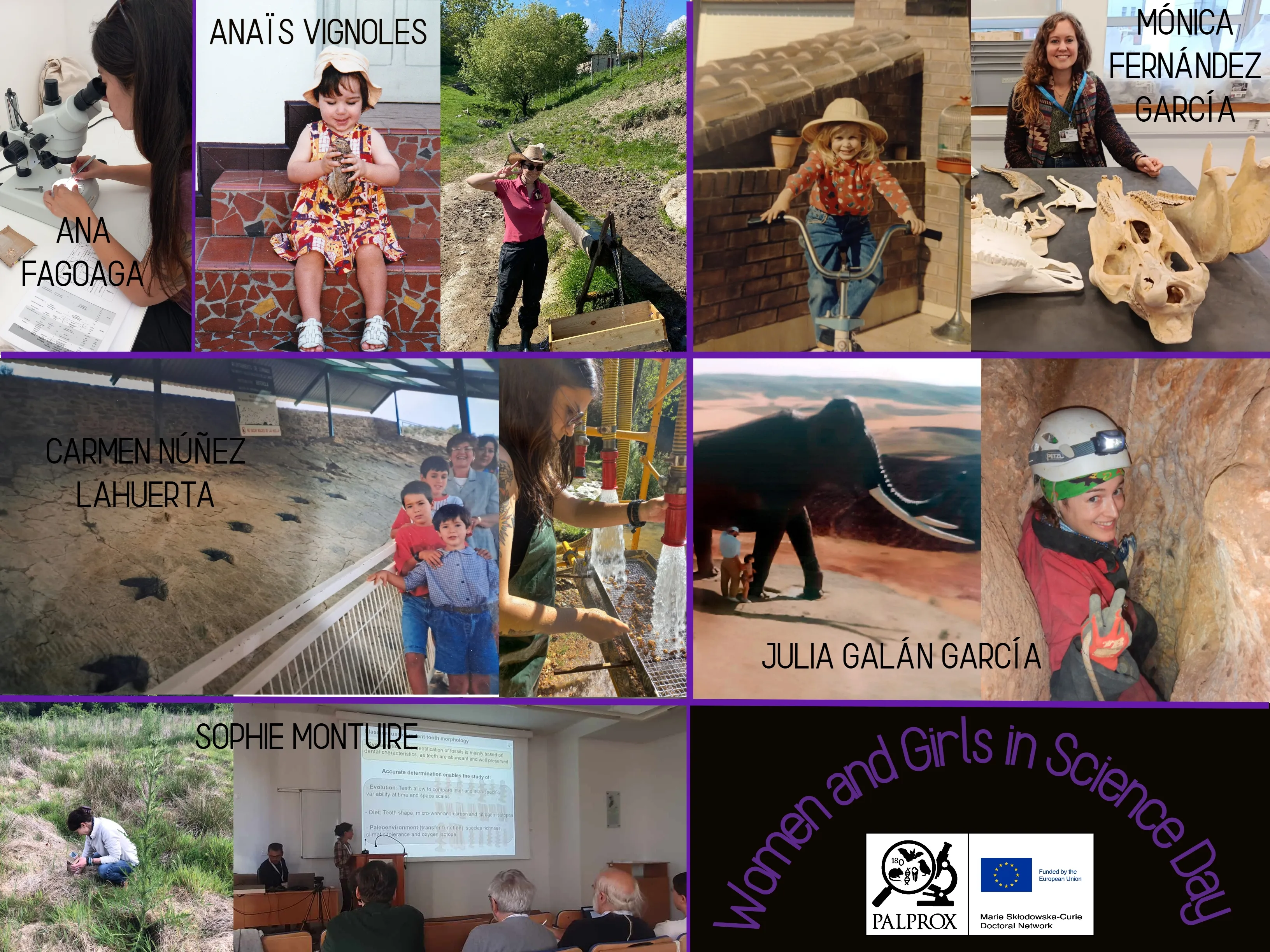
Dr Sophie Montuire is Director of Studies at the École Pratique des Hautes Études and conducts her research at the Biogéosciences Laboratory in Dijon (France), where she studies the evolution of rodents in relation to climate change. Within PALPROX, she is involved in the supervision of candidates at Université Bourgogne Europe working on rodent species and niche evolution.
Dr Julia Galán García is a Postdoctoral Researcher and Humboldt Research Fellow at the Senckenberg Society for Nature Research, and an associated researcher at IPHES-CERCA. She is the main supervisor of an IRP focused on applying new approaches to the study of fossil bat remains.
Dr Carmen Núñez Lahuerta is a specialist in bird remains and eggshells, with extensive experience in both research and fieldwork activities. She is an associated researcher at IPHES-CERCA and the main supervisor of an IRP focused on corvid diversity during the Late Pleistocene.
Dr Anaïs Vignoles is a postdoctoral researcher in the ECOLITHIC project, and a prehistoric archaeologist interested in lithic technological evolution, the interaction between past material cultures and regional climates over evolutionary time scales, and the relationship between ecological and technological diversity. Within PALPROX, she co-supervises an IRP involving the evolution of ecological niches in rodents.
Dr Mónica Fernández García is a Marie Skłodowska-Curie Researcher (NEANSCAPES) at the University of Lancashire (Preston, UK) and an affiliated researcher at IPHES-CERCA (Tarragona). Her research focuses on the characterisation of ecological and climatic conditions related to Palaeolithic human dynamics. She is the main supervisor of an IRP focused on ecological and geochemical analyses of rodent remains.
Dr Ana Fagoaga is a researcher at Fundação para a Ciência e a Tecnologia (University of Porto) and an affiliated researcher at IPHES-CERCA (Tarragona). She is a palaeontologist working on climatic reconstructions of Quaternary environments through the study of microvertebrates associations, as well as on the improvement and automation of methods for obtaining quantitative climatic reconstructions. Within PALPROX, she co-supervises an IRP concerning corvid spatial distribution using GIS tools.
Across the PALPROX consortium, women scientists play key roles at all stages of the project: from shaping research questions and supervising PhD students to analysing data, leading fieldwork, developing methodologies and disseminating results. Their scientific trajectories are diverse, yet their stories reveal shared motivations, common challenges and a strong commitment to both scientific excellence and collaboration.
PALPROX women reflect on Women and Girls in Science Day
For many of the women involved in PALPROX, the decision to pursue a career in science was rooted in curiosity and a fascination with understanding the world around them. As Anaïs Vignoles explains, “I have always been very curious about the nature around me, collecting samples, observing and asking questions.” Others discovered their vocation later, through university studies or first research experiences. As Mónica Fernández reflects, “a vocation doesn’t have to appear in childhood — it can develop later.” Together, their stories challenge the idea of a single “scientific vocation” and show that there are many valid routes into research.
A recurring source of motivation across the consortium is the joy of discovery and learning. Whether working on palaeontology, archaeology, ecology or geochemistry, PALPROX researchers repeatedly highlight the importance of intellectual exchange, interdisciplinary collaboration and collective work. “There is always something new to learn,” notes Sophie Montuire. For Julia Galán, motivation is also closely linked to the collaborative nature of research: “Working with people from different disciplines and backgrounds is what makes science both challenging and rewarding.” These reflections underline how collaboration lies at the heart of both the project and scientific progress more broadly.
Alongside these positive aspects, many women acknowledge that challenges remain within academic careers. Balancing professional and personal life, particularly in a context of high mobility and demanding schedules, is frequently mentioned. Anaïs Vignoles describes it as “a constant work in progress,” while Sophie Montuire points out that “going on missions for varying lengths of time is not always easy, but it is manageable with good support.”
Several researchers also point to subtler barriers, such as difficulties in being recognised as leaders, particularly in traditionally male-dominated settings like fieldwork, or the need to constantly prove competence and authority. More serious issues, including sexism, power abuse and sexual harassment, are also acknowledged as realities that continue to affect women in science, underscoring the importance of safe and supportive working environments. These experiences often shape how women in the consortium reflect on the meaning of the International Day of Women and Girls in Science.
For Carmen Núñez, this day is essential to make women’s contributions visible while recognising that inequalities persist: “This initiative is important to show that women can do science, while reminding us that there are still many issues we need to keep working on.” Ana Fagoaga adds “It’s a day to claim our place in science”.
Beyond visibility, the day also serves as a moment for collective reflection. As Mónica Fernández notes, “Women and Girls in Science Day is not only important for women, but for the entire scientific community — it invites us to reflect on how to make academia a better place for everyone.”
This perspective is shared by Julia Galán, who emphasises the broader significance of the day: “It is a valuable opportunity to reflect collectively on the challenges women still face in science, and on how we can address them within our own work environments.” Together, these reflections highlight the importance of combining visibility, critical reflection and collective responsibility in order to foster more inclusive research environments.
Confidence and resilience are often built through supportive environments. Mentorship, encouragement from supervisors, sorority and solidarity among colleagues and recognition through publications, conferences and student supervision are repeatedly cited as key factors. Julia Galán highlights the importance of teamwork and trust, noting that “feeling supported within a research group makes a real difference, especially in the early stages of a career.” Sophie Montuire reflects that “having people who listen to you and discuss your work with you makes all the difference,” while Ana Fagoaga emphasises the value of “sharing doubts and reflections with colleagues in order to progress together.” Many PALPROX researchers stress how important it is for experienced scientists to actively support the next generation by mentoring, sharing experience, promoting inclusive practices and occupying decision-making positions where meaningful change can happen.
When speaking about role models, the answers extend beyond well-known historical figures such as Marie Skłodowska-Curie, Jane Goodall or Lynn Margulis. While these scientists remain powerful symbols, many PALPROX researchers highlight the influence of colleagues, supervisors, friends and family members. “The women around me when I started my career were the ones who inspired me the most,” explains Carmen Núñez, reinforcing the importance of everyday role models and strong support networks.
The messages addressed to girls interested in science are clear, consistent and encouraging. “Go for it!” is a recurring response across the consortium. Curiosity, perseverance and confidence emerge as shared themes. As Mónica Fernández advises, “Never think ‘I cannot do this’ — most men never question it.”
At PALPROX, promoting gender diversity is not only a matter of fairness, but also of scientific quality. Diverse perspectives enrich research, foster innovation and lead to more robust and impactful outcomes. On the International Day of Women and Girls in Science, PALPROX proudly recognises the women of the consortium, their contributions to the project and their role in shaping both the present and the future of science.
By making these voices visible, PALPROX reaffirms its commitment to equality, collaboration and excellence — and to creating a research environment in which the next generation of women scientists can thrive.
Share

Funded by the European Union
Views and opinions expressed are however those of the author(s) only and do not necessarily reflect those of the European Union or the Marie Skłodowska-Curie Actions. Neither the European Union nor the granting authority can be held responsible for them