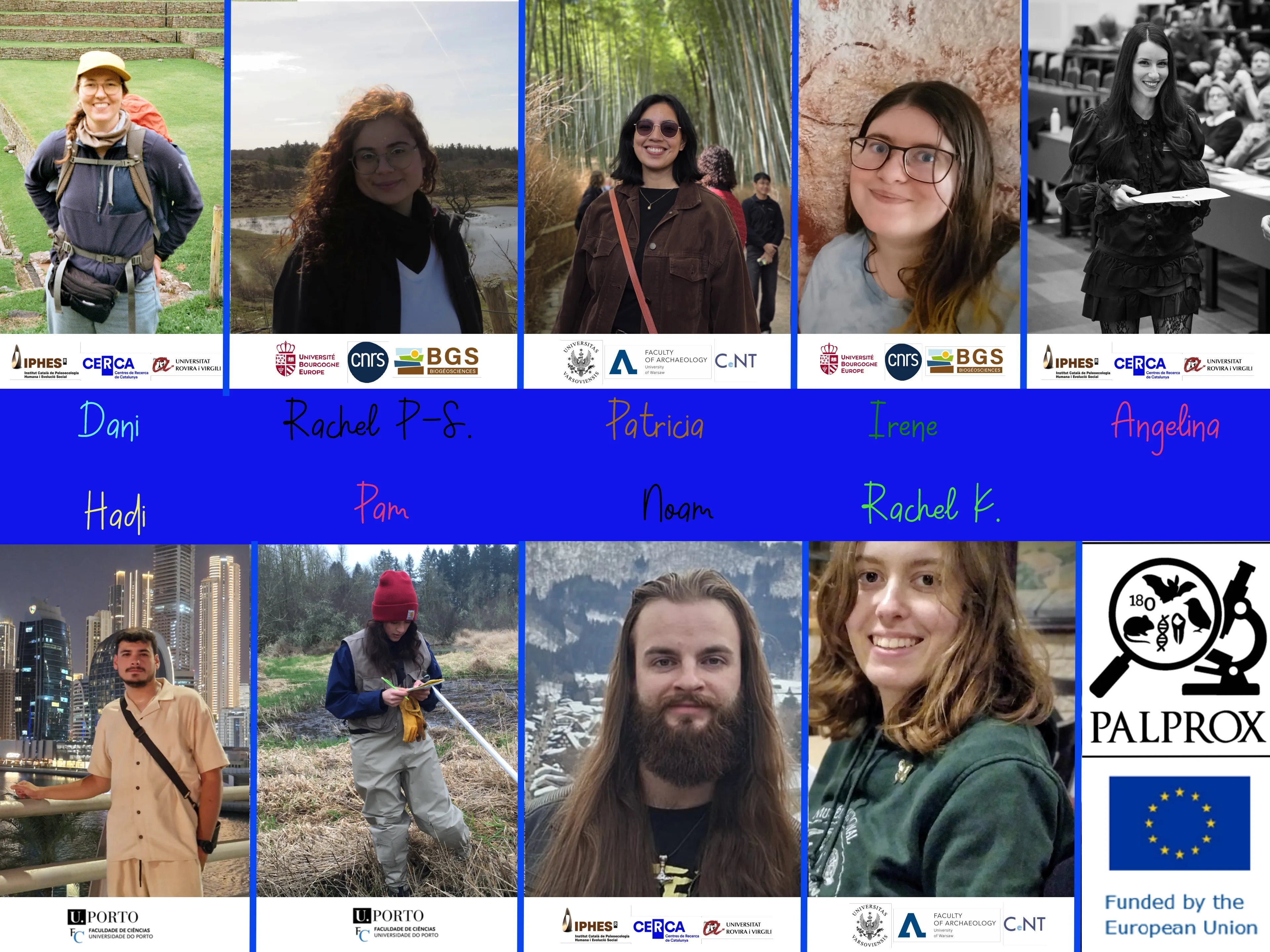
Nine researchers. Nine projects. One shared scientific journey
Meet the PALPROX Doctoral Candidates
The PALPROX Doctoral Candidates come from different countries, academic backgrounds and research traditions, but they share a common curiosity: what can small vertebrates tell us about the past?
Their projects bring together archaeology, palaeontology, biology, ecology, environmental sciences and remote sensing, using approaches ranging from 3D geometric morphometrics and GIS to ancient DNA, stable isotopes, geochemistry, statistical modelling and satellite remote sensing.
Over the next three years, these nine researchers will investigate different species, environments and periods, while developing new ways of combining methods and perspectives. Their work is diverse but connected by a common goal: understanding past environments, climate change, ecological dynamics and human–environment relationships through the evidence preserved by small vertebrates.
Meet the researchers behind the projects — and discover the stories, questions and ideas that brought them to PALPROX.
Meet Noam!
With a background in Biology, palaeontology and comparative anatomy, Noam developed an interest in morpho-functional research before discovering PALPROX. In IRP1, he investigates cryptic bat species through their postcranial skeletons, using 3D geometric morphometrics and micro-CT to improve species identification and explore how past climate and environmental change influenced skeletal morphology.
Outside research, he enjoys metal music, Muay Thai, and anything related to fantasy and science fiction.
Meet Angélina!
Angélina's long-standing interests in Prehistoric Archaeology and birds naturally led her towards zooarchaeology and the study of prehistoric bird remains. In IRP2, she investigates the diversity and evolutionary history of European Pleistocene corvids, combining osteological analysis with GIS and distribution modelling to explore their biogeographic history and responses to climate and landscape change.
She is particularly excited about learning new methods, developing her skills and becoming part of an international research community.
Outside research, Angélina enjoys birdwatching, vintage shopping, baking, tea, rock and goth music, video games and reading.
Meet Irene!
Irene's curiosity about the natural world eventually led her from Biology and Terrestrial Biodiversity to Human Evolution and Pleistocene mammals. While working on Iberian marmots, she discovered morphometrics and ancient DNA — and, in her own words, fell in love with Rodentia.
In IRP3, she investigates the evolutionary history and biogeography of cryptic vole species, combining geometric morphometrics and ancient DNA to explore species identification, population variability and lineage renewal in relation to climate change over the last 100,000 years.
Outside research, Irene enjoys exploring, reading, painting and drawing, playing video games and discovering new places.
Meet Rachel P-S!
Rachel is a biologist with an MSc in Biogeosciences and Evolution, with research experience spanning palaeontology, ecology and palaeoecology. Her work with fossil pigs and rodent bioclimatic modelling sparked her interest in combining fossil evidence with analytical tools such as GIS and R.
Within IRP4, she investigates how the ecological niches of rodents have evolved through time, combining fossil data with ecological niche modelling to explore the roles of climate, environmental change and competition in shaping species distributions.
Outside research, she enjoys music, karaoke, salsa dancing, hiking, reading and spending time with family and friends.
Meet Patricia!
Patricia's path into zooarchaeology began during her Anthropology degree in the Philippines, when research work introduced her to the study of animal remains. Her experience with material from Callao Cave sparked a particular interest in the taphonomy of fossil small mammals.
As part of IRP5, Patricia develops new statistical approaches to reconstruct Late Pleistocene climate from fossil small vertebrate assemblages, combining climate modelling with chronological information, including radiocarbon and aDNA datasets.
Outside research, Patricia enjoys hiking, long walks, cooking familiar meals and exploring local markets.
Meet Dani!
Growing up near Lake Constance, close to a prehistoric archaeological museum, Dani developed an early interest in archaeology. She later studied Archaeology and Geography and became particularly interested in stable isotopes and their potential for reconstructing past environments.
Within IRP6, Dani investigates Late Pleistocene climatic changes and human palaeoecology through the ecological and geochemical analysis of rodent remains. By combining taxonomic and taphonomic information with stable isotope analysis of teeth, she will reconstruct past environmental conditions and explore their relationship with human subsistence.
Outside research, she loves hiking, cycling, swimming, flea markets and searching for curious treasures. Her favourite bird is the toucan!
Meet Rachel K.!
Rachel's path into palaeoecology took her from Health Sciences and Biology to zooarchaeology and microvertebrate research. She has worked with small mammal remains and Pleistocene herpetofauna and participated in several Palaeolithic excavations in France and Spain, including Atapuerca and Gran Dolina.
As part of IRP7, she investigates small vertebrate population dynamics during major climatic events of the early Late Pleistocene, focusing on MIS 5 and MIS 4. Her research combines climate and environmental reconstruction, chronology and ancient DNA to explore population changes across Europe.
Outside research, Rachel enjoys reading and writing, discovering new series and spending time with family and friends.
Meet Pam!
Growing up in Guatemala City, Pam became interested in the relationship between people and natural ecosystems. Her background in Environmental Studies includes research on aquatic ecosystems and restoration ecology, working with species ranging from salmon and frogs to gophers and bats.
In IRP8, Pam investigates how palaeo-rivers influenced the distribution of microvertebrates, combining Synthetic Aperture Radar (SAR), ecological niche modelling and Google Earth Engine to identify ancient river systems and explore their influence on species distributions.
Outside research, she loves trail running, cycling, CrossFit, boxing, yoga, basketball and pickleball, as well as reading and going to the theatre.
Meet Hadi!
Hadi's background in surveying, geodesy and remote sensing led him to develop expertise in satellite data processing, GIS, Python and Google Earth Engine. At the same time, archaeology and cultural heritage remained a long-standing personal interest.
Within IRP9, Hadi investigates how remote sensing data can be used to identify and characterise potential archaeological sites associated with microvertebrates. He will develop probability maps of potential undiscovered sites and explore how the methodology can be transferred across different spatial scales.
Outside research, he enjoys painting and drawing, woodworking, walking, music and history books and films.
With all nine Doctoral Candidates now on board, the PALPROX team is finally complete! We are delighted to welcome them to the project and look forward to seeing their research develop over the coming years. We are especially excited to meet them all in person, share ideas, learn from each other and begin this journey together. There is a lot to look forward to!
Share

Funded by the European Union
Views and opinions expressed are however those of the author(s) only and do not necessarily reflect those of the European Union or the Marie Skłodowska-Curie Actions. Neither the European Union nor the granting authority can be held responsible for them