Learning, sharing and connecting: the first PALPROX School in Warsaw
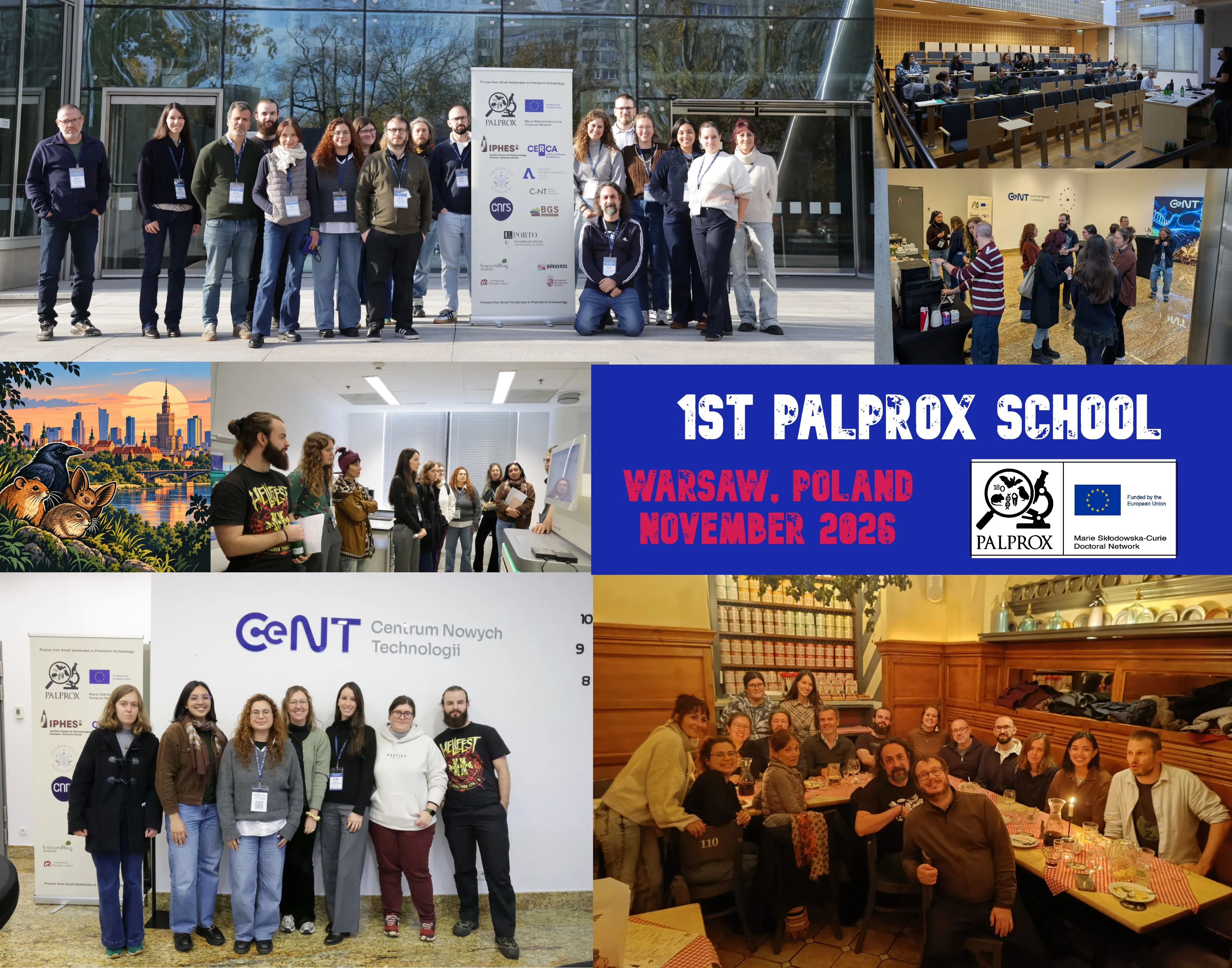
Four days of scientific training, interdisciplinary exchange and networking brought together the PALPROX doctoral researchers and supervisors in Warsaw, Poland, from 3 to 6 November 2026.
By Patricia Cabrera and Rachel Kiefer (PALPROX Doctoral Candidates, University of Warsaw)
PALPROX is a European doctoral network funded by the Marie Skłodowska-Curie Actions (MSCA) programme. It trains a new generation of researchers to use small vertebrates (rodents, bats and birds) as environmental proxies in archaeological contexts, developing new methods to improve our understanding of past environments and climate change.
The PALPROX Schools play an essential role in our training. They complement our individual research projects by combining classical approaches in palaeontology with more recent analytical methods, including genetics and proteomics. They also provide valuable opportunities to exchange knowledge with specialists from different disciplines, share experiences and develop common scientific and methodological skills.
The first PALPROX School took place from 3 to 6 November 2026 at the Centre of New Technologies (CeNT), University of Warsaw, Poland. It brought together 17 participants, including seven of the nine doctoral candidates in the network, as well as most of the project's supervisors and researchers. For many of us, this was the first opportunity to meet face to face, share knowledge and begin building the scientific connections that will accompany us throughout our PhD journeys.
Exploring small vertebrates: from taxonomy to new approaches
The scientific programme was organised around three main themes: taxonomy, taphonomy and new analytical approaches. Together, these sessions provided an overview of the methods and research perspectives that will contribute to our work within PALPROX.
Taxonomy
The taxonomy sessions introduced us to the historical development of small vertebrate research, as well as to modern approaches for identifying and classifying fossil remains. Through contributions from Dr Claudio Berto, Dr Sophie Montuire, Dr Nicolas Navarro, Dr Juan Manuel López-García and Prof Dr Gloria Cuenca Bescós, we explored the foundations of small mammal systematics, diagnostic characteristics and the potential of morphometric approaches. Coming from different academic backgrounds and with varying levels of previous knowledge, we particularly appreciated the opportunity to establish a common foundation. One message stood out throughout these sessions: the importance of asking the right research questions and allowing them to guide methodological decisions.
Taphonomy
The taphonomy sessions focused on the processes affecting animal remains from the death of an organism to the discovery of its fossilised remains, including accumulation, modification and preservation. Through lectures by Dr Iván Rey-Rodríguez, Dr Claudio Berto, Dr Mónica Fernández García and Dr Aurélien Royer, we explored the role of predators in the accumulation of small vertebrate remains, the effects of post-depositional processes and the importance of appropriate recovery, documentation and conservation techniques. We also took part in a Kahoot quiz on the traces left by digestion, which made the sessions particularly interactive! One particularly interesting takeaway was that even apparently minor decisions, such as the choice of pencil used to label and document fossils, can make a difference to the long-term preservation of information.
New approaches
The final scientific sessions explored how new analytical techniques can expand our understanding of fossil small vertebrates and the environments they inhabited. Dr Mateusz Baca, Dr Aurélien Royer and Dr Mónica Fernández García introduced us to palaeogenetics, palaeoproteomics and stable isotope analysis, highlighting their applications in reconstructing past population dynamics, identifying fossil microfauna and investigating past environmental and climatic conditions. One of the highlights was the opportunity to visit the CeNT laboratory and take part in a hands-on exercise involving the analysis of ancient DNA sequences. Through this activity, we explored the potential impact of Younger Dryas cooling on common vole populations in Central Europe. It was exciting to connect theoretical knowledge with practical research!
Getting to know the PALPROX community
Beyond the scientific programme, the School also gave us the opportunity to get to know the people behind PALPROX and better understand how the network operates.
During a dedicated meeting, the PALPROX Principal Investigator, Dr Juan Manuel López-García, and Project Assistant, Dr Alexia Serrano, introduced us to the project's structure, resources and online platforms. We also met our supervisors and learned more about their diverse academic backgrounds and areas of expertise. It was inspiring to see how different disciplines and experiences complement one another, reminding us that this diversity is one of PALPROX's greatest strengths.
Each doctoral candidate then gave a five-minute presentation introducing themselves, their research interests and the decisions that had led them to join PALPROX. These presentations also allowed us to outline our Individual Research Projects (IRPs). It was exciting to see how each project, which had initially seemed rather abstract, was gradually taking shape through more specific research questions, objectives and methods.
Of course, getting to know one another was not limited to the lecture room! The School also provided opportunities to share experiences outside the academic programme. One of these moments was the group dinner at Kompania Piwna, a restaurant serving traditional Polish cuisine in Warsaw's historic Old Town. The evening coincided with the birthday of our colleague Noam, and the restaurant musicians dedicated a rendition of "Sto lat!" to him, a traditional Polish song often sung to celebrate birthdays. It was a lovely opportunity to relax, share a hearty meal and get to know one another better.
Looking ahead
Looking back, the first PALPROX School was a rewarding experience, both scientifically and personally. It allowed us to broaden our knowledge, discover new analytical approaches and, perhaps most importantly, begin building the connections that will make our doctoral network a truly collaborative community.
We would like to thank our supervisors, Dr Claudio Berto and Dr Mateusz Baca, Mgr Barbara Bujalska and Dr Alexia Serrano for organising the School and making sure that everything ran smoothly (and that nobody went hungry!) in Warsaw. We are also grateful to all the supervisors and invited speakers for sharing their knowledge and expertise.
And, of course, to our fellow doctoral candidates Noam, Angelina, Rachel, Daniela, Irene, Hadi and Pam: it was wonderful to meet you all, exchange ideas and share these first experiences together. We look forward to seeing everyone again at the next PALPROX meetings!
Share

Funded by the European Union
Views and opinions expressed are however those of the author(s) only and do not necessarily reflect those of the European Union or the Marie Skłodowska-Curie Actions. Neither the European Union nor the granting authority can be held responsible for them