From Ice Age Landscapes to Forest Worlds: Exploring Poland’s Heritage through PALPROX
International Day for Monuments and Sites: understanding the past to protect the future
Each year on 18 April, the International Day for Monuments and Sites highlights the importance of cultural heritage and the need to safeguard it for future generations. Established by ICOMOS in 1982 and later endorsed by UNESCO, this global initiative invites communities, researchers, and institutions to reflect on the value of monuments, archaeological sites, and cultural landscapes.
Cultural heritage is not only a legacy of the past. It plays a key role in shaping shared identities, supporting sustainable development, and fostering dialogue between cultures. Archaeological sites, historic buildings, and landscapes help us understand how societies have evolved and how humans have interacted with their environments over time.
In this context, European research projects are essential for improving the study, documentation, and protection of archaeological heritage through innovation and collaboration.
PALPROX: new perspectives on past environments
PALPROX (Proxies from Small Vertebrates in Prehistoric Archaeology) is an international doctoral network funded by the Marie Skłodowska-Curie Actions. It brings together institutions across Europe to advance research in archaeology and palaeoenvironmental studies.
The project focuses on small vertebrates—such as rodents, bats, and birds—as highly sensitive indicators of past environmental and climatic conditions. Because these animals depend strongly on local habitats and have limited mobility, their fossil remains provide detailed snapshots of past ecosystems.
By analysing material from well-documented archaeological sites, PALPROX investigates how environments and species responded to climate change during the Late Pleistocene. These long-term records are highly relevant today, contributing to current discussions on climate change, biodiversity loss, and conservation.
The project combines traditional archaeological approaches with advanced methods, including geometric morphometrics, isotopic analysis, ancient DNA, and spatial modelling. At the same time, it trains a new generation of researchers through interdisciplinary collaboration, equipping them to address challenges in both heritage science and environmental research.
A key region: the Cracow–Częstochowa Upland (Poland)
The Cracow–Częstochowa Upland, located in southern Poland, is a karst landscape rich in caves and rockshelters. Since the nineteenth century, it has attracted archaeological interest due to its exceptional preservation of prehistoric remains.
Research in the area has evolved from early explorations to systematic, interdisciplinary investigations. Today, the valley is recognised as a key region for understanding human occupation from the Middle Palaeolithic through the Mesolithic and Neolithic, as well as later periods.
Its sites are particularly valuable because they preserve well-stratified deposits and rich faunal assemblages, making them ideal for reconstructing past environments and human behaviour.
Climate change and human adaptation
The archaeological record of the area is closely linked to the major climatic changes at the end of the last Ice Age. Until around 20,000–25,000 years ago, much of northern Europe was covered by ice sheets, and surrounding areas were dominated by cold, open environments.
As temperatures increased, landscapes gradually transformed, from steppe-tundra to birch and pine woodlands, and eventually to dense forests during the Holocene. These changes had a profound impact on human populations.
Hunter-gatherer groups adapted by modifying their mobility, subsistence strategies, and technologies. This transition is reflected in the shift from the Palaeolithic to the Mesolithic, when communities increasingly adapted to forested environments.
Key archaeological sites in the PALPROX project
Tunel Wielki Cave
Tunel Wielki Cave preserves one of the longest archaeological sequences in the region. Some of the oldest stone tools discovered here date between 450,000 and 600,000 years ago and are attributed to the first inhabitants of Poland.
These findings represent some of the earliest evidence of human presence in present-day Poland and provide key insights into early human adaptation to challenging climatic conditions.
The cave also contains evidence of later occupations, illustrating its long-term use across different periods.
More information: https://www.nature.com/articles/s41598-022-20582-0
Koziarnia Cave
Koziarnia Cave is one of the most important sites in the valley, with evidence of human occupation from the Middle and Upper Palaeolithic onwards.
Recent research has applied a multiproxy approach—combining pollen, charcoal, molluscs, vertebrate remains, and biomolecular data—to reconstruct environmental conditions during a highly dynamic climatic period (ca. 45,000–29,000 years ago).
The results reveal rapid environmental changes, from cold open landscapes to milder phases with woodland development. These shifts directly influenced human occupation patterns, with different groups using the site under varying climatic conditions.
Read more: https://www.sciencedirect.com/science/article/pii/S2352409X20305149
Sąspowska Zachodnia Cave
This cave, located on the northern slope of the valley, contains archaeological remains from the Neolithic, Roman period, and Middle Ages. It is particularly rich in flint artefacts linked to nearby mining activities.
In addition to its archaeological importance, the site has provided valuable environmental data. Studies of small vertebrates and other faunal remains have helped reconstruct environmental changes during the transition from the Late Pleistocene to the Early Holocene.
More information: https://doi.org/10.1016/j.quaint.2021.09.010
Ciasna Cave
Ciasna Cave, located high on the southern slope of the valley, has become increasingly important for palaeoenvironmental research.
Analyses of its sediments and faunal remains show clear shifts in habitat conditions over time, reflecting broader climatic fluctuations. These data contribute to a more detailed understanding of how local environments evolved at the end of the last Ice Age.
Bramka Rockshelter
Bramka Rockshelter is a natural rock shelter located on the northern slope of the valley. Around 9,700 years ago, it was used by Early Mesolithic hunter-gatherers associated with the Komornica culture.
This site is particularly remarkable because Mesolithic cave occupations are rare north of the Carpathians. Bramka preserves one of the most interesting Early Mesolithic assemblages in Poland.
Thousands of flint artefacts found at the site—mostly production waste—indicate that it functioned as a flint knapping workshop near local raw material sources. Radiocarbon dating confirms its Early Holocene occupation and later reuse, including a Bronze Age burial.
Learn more: https://www.sciencedirect.com/science/article/pii/S1040618221004511
PALPROX research in Poland
Within PALPROX, research in Poland focuses on reconstructing past climates using small vertebrate assemblages.
At the University of Warsaw, different research lines are developing innovative statistical and molecular approaches to estimate past temperature and precipitation, and to understand how small mammal communities responded to climatic shifts during the Late Pleistocene.
By combining fossil data, radiocarbon dating, and ancient DNA, these studies contribute to more robust environmental reconstructions and improve our understanding of ecological change over time.
_________________________________________________________________________________________
The International Day for Monuments and Sites reminds us that cultural heritage is a shared and fragile resource. Archaeological sites are particularly vulnerable: once damaged, the information they contain is lost forever.
Projects such as PALPROX demonstrate how research, innovation, and international collaboration can enhance both the study and protection of heritage. By deepening our understanding of past environments and human adaptation, they help ensure that archaeological sites continue to inform and inspire future generations.
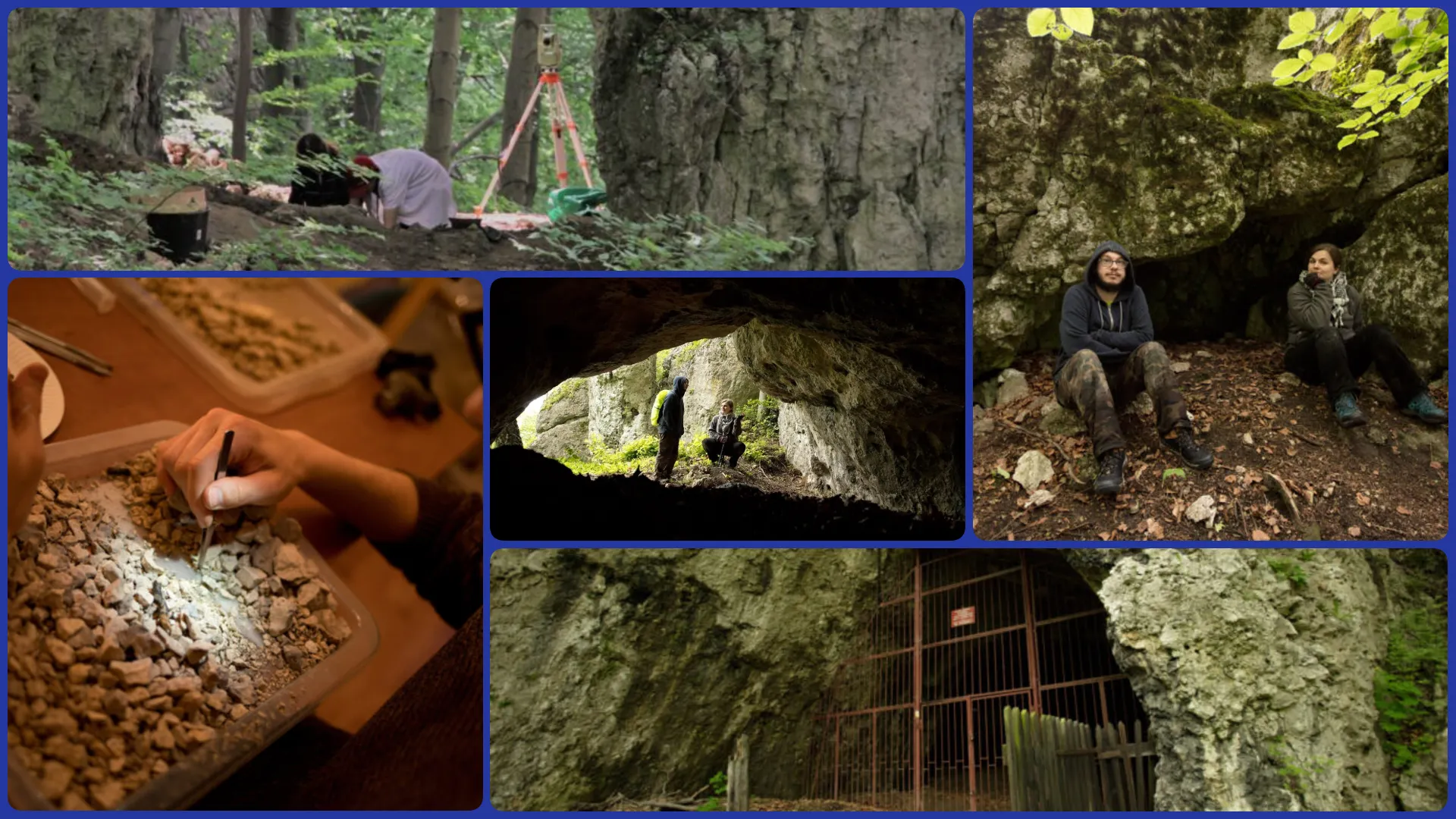
(Top left) Excavations at the Bramka Rockshelter in 2017. © M. Kot, CC BY-NC-SA 4.0 licence.
(Top right) Profs. C. Berto and M. Kot at the north-eastern entrance of Ciasna Cave. © M. Bogacki, CC BY-NC-SA 4.0 licence.
(Centre) Profs. C. Berto and M. Kot at the entrance of Tunel Wielki Cave. © M. Bogacki, CC BY-NC-SA 4.0 licence.
(Bottom left) Careful selection of bones, shells, charcoal, and small artefacts recovered through flotation of cave sediments from Sąspowska Zachodnia Cave. © M. Bogacki, CC BY-NC-SA 4.0 licence.
(Bottom right) View of the entrance to Koziarnia Cave. © M. Bogacki, CC BY-NC-SA 4.0 licence.
Share

Funded by the European Union
Views and opinions expressed are however those of the author(s) only and do not necessarily reflect those of the European Union or the Marie Skłodowska-Curie Actions. Neither the European Union nor the granting authority can be held responsible for them